
Recent surveys show that the majority of
businesses plan to increase their digital marketing budgets over the next 12
months. These increases mean stiffer competition and growing rates to achieve
the desired level of impressions and performance.
Today’s internet marketing practices have
matured dramatically since the days of dial up. Channels like social media have
likewise matured, changing the landscape from a “Wild West” feeling to a more
familiar competitive market. As businesses spend more on aspects of marketing
like paid ad inventory, prices go up. There is, after all, a finite number of
eyeballs browsing the internet at any given time.
Businesses also find themselves competing more
earnestly for organic traffic and impressions. While it used to be easy to rank
high on search engines if you were the only business on the block doing SEO,
now achieving results pits you against countless others.
With all this going on, business owners should
expect to dig deeper into their pockets in the near future in order to achieve
their goals for awareness, revenues, growth, and more. To help encourage you to
keep pace, here are some observations we’ve made that reveal the current state
of online marketing and indicate where it could be going soon.
Survey Says: Online Marketing Spending Growth Outpaces Traditional Ads
In a recent survey of CMOs, the respondents
indicated that they [intend to increase their digital marketing spending by\\
15.1%](https://cmosurvey.org/wp-content/uploads/sites/15/2018/02/The_CMO_Survey-Highights_and_Insights_Report-Feb-2018.pdf)
on average. By comparison, the average respondent
said they plan to shrink their traditional advertising spending by 1.7%.
The decrease follows a distinct trend of
budgets shrinking for traditional media, which includes ads on TV, radio,
print, billboards, and other non-digital channels. The last time budgets
increased by more than 1% was in 2011. Since that point, budgets were cut by an
average of 1.6% every six months. That’s a total drop of 22% in traditional ad
spending from 2011 to the present.
In the meantime, digital marketing budgets
have increased by double digits every six months with only one exception. The
changes equal a 167.5% increase, for an average of 12% every six months.
Spending on digital and traditional marketing
techniques is diverging, and the effects are more noticeable in certain
industries. Business-to-consumer (B2C) companies in particular say that they
will have the biggest jumps. Product-focused B2C companies intend to increase
digital marketing budgets by 17.9%, and service-based B2C companies say they
will increase their budgets by 18.2%.
All of these data points indicate a steady
stream of dollars flowing into digital channels. Companies in all sectors are
investing more in online marketing campaigns, including content creation,
strategy, management, promotion, and actions like performance measurement.
Budgets Stay Largely Flat as a Portion of Marketing Spending and Revenues
While budgets are increasing across the board
for most companies, the ratio of that budget to other key metrics has remained
stable for the most part.
The current industry average for marketing
budgets as a portion of overall spending sits at 11.1%. This ratio is mostly
unchanged since 2011. Similarly, marketing spending as a portion of company
revenues is an average of 7.9% this year. That number has increased and
decreased by small increments since 2012, barring a slight jump and then
regression in Fall 2012.
So what does this mean in terms of trends?
Well, if spending is increasing but budgets as a ratio are staying flat, that
indicates that companies tie their spending growth to sales growth and budget
growth. You could chalk these strong correlations to inflation or a general
growth trend in both revenues and spending. You could also observe that, across
all industries, spending strategies remain fairly conservative.
But a few key distinctions are to be made if
you take the time to break down spending further. For instance, the ratio of
money spent on content marketing compared to a business’s entire budget can
dictate their ability to accomplish their content marketing goals.
In a survey of B2C companies using content marketing
,
the average respondent said they spent 22% of their marketing budget on
content. The companies that rated themselves as “least successful” at
accomplishing their goals spent an average of 18%, while the companies that
said they were the “most successful” spent 26%.
These differences were even more pronounced
among business-to-business (B2B) companies. The average B2B content marketing
spend was 26% of their overall marketing budget. Yet, the least successful
companies spent just 14%, while the most successful ones spent a whopping 40%
on average.
So, while the aggregated data may hint that
online marketing spending strategies are conservative, companies that lean into
their digital marketing campaigns with a larger budget percentage tend to see
better performance.
Costs of Online Advertising on the Rise
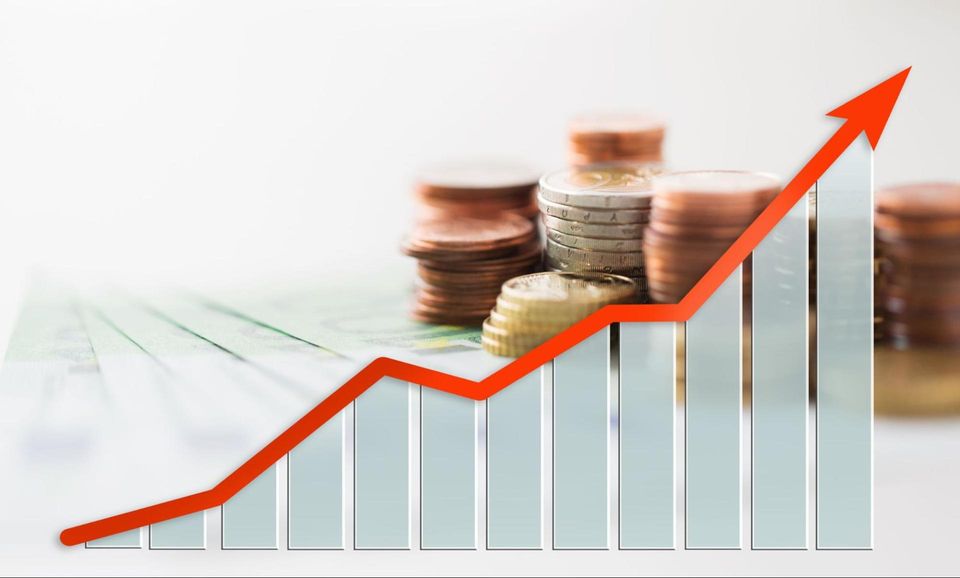
One of the biggest factors encouraging
companies to increase their budgets is that costs have risen. According to a
study by Adobe, the [costs of digital advertising are rising five times faster\\
than the current rate of inflation](http://thenewnewthing.com/10-stats-on-the-state-of-digital-advertising-in-2017/ "Link: http://thenewnewthing.com/10-stats-on-the-state-of-digital-advertising-in-2017/")
in the U.S.
Looking at data from 2014 to 2016, mobile
display ad prices increased 12%, video ads increased 13%, and mobile paid
search ads went up 11%.
Overall, companies spent 42% more on search
advertising. At the same time, search engine traffic increased by just 11%.
These two observations together mean that competition is getting more fierce
for smaller slices of traffic.
Similar trends can be seen with social media
advertising. Companies engaging in social media marketing are having a harder
time earning impressions organically. To compensate, they are increasing their
volume of paid social campaigns as well as their budgets. Bid prices for
limited ad inventory go up.
In total, experts predict that ad prices for Facebook could rise
anywhere between 25% and 79% in the coming year.
Few Companies Measuring Performance, Impact and ROI

As the costs of marketing rise, it’s more
important than ever to measure impact and performance. Without this data,
businesses could spend on campaigns and activities that don’t bring them
measurable value.
Also, they lack the data to optimize their
campaigns over time. Without knowing, for instance, that one social media
campaign type brought better performance than another, the business will have
fewer decision-making tools in hand to strategize for future campaigns.
Despite the risks described above, 58% percent
of companies don’t use marketing analytics to measure performance and help them
make decisions. For social media marketing, 34% of companies don’t measure the
impact of their campaigns at all. 42% claim they have a good “qualitative
sense” of how their campaigns are performing but don’t have the numbers to back
up these observations.
The situation is even more dire with content
marketing. 5% of companies don’t have any content marketing target metrics to
speak of. 41% don’t measure content marketing ROI, and 21% say they are
“unsure” as to whether they are accurately measuring ROI.
Every penny you spend on digital marketing
counts, especially as costs rise. Make sure you have a strategy in place to
maximize your returns, as well as tools you can use to measure those returns
quantifiably.
If you need help getting to this point, we’re
here for you. Contact us today for assistance with planning, executing,
measuring, and optimizing your digital marketing strategies.
Get prepared for the future with the expertise
you need to compete and stay ahead as the digital marketing realm becomes more
expensive.